How do medical gas systems function?
News Details
Every day, hospitals rely on a silent system hidden inside the walls. That system carries oxygen, medical air, and suction to beds, operating rooms, and intensive care units. It is called a medical gas system. This article explains how it works in plain steps so buyers, distributors, and project planners can understand the path from gas source to patient.
What Is a Medical Gas System?
A medical gas system, also called a medical gas pipeline system (MGPS), is a central network that stores, controls, and delivers medical gases inside a healthcare facility. It connects a central supply source to medical gas outlets at the point of care.
Instead of moving heavy cylinders from room to room, staff connect equipment to a wall outlet. The system keeps pressure stable and supply continuous, 24 hours a day.
Which Gases Does the System Deliver?
| Gas | Common Use |
|---|---|
| Oxygen (O2) | Breathing support in ICUs, operating rooms, and wards |
| Medical air | Ventilators and breathing equipment |
| Surgical air | Powering surgical tools at higher pressure |
| Nitrous oxide (N2O) | Anaesthesia and pain relief |
| Carbon dioxide (CO2) | Laparoscopic surgery |
| Nitrogen | Driving pneumatic instruments |
| Medical vacuum | Suction for surgery and airway clearance |
Medical vacuum is a suction service rather than a gas, but it runs through the same type of pipeline network and is a core part of every medical gas system.
Main Components of the System
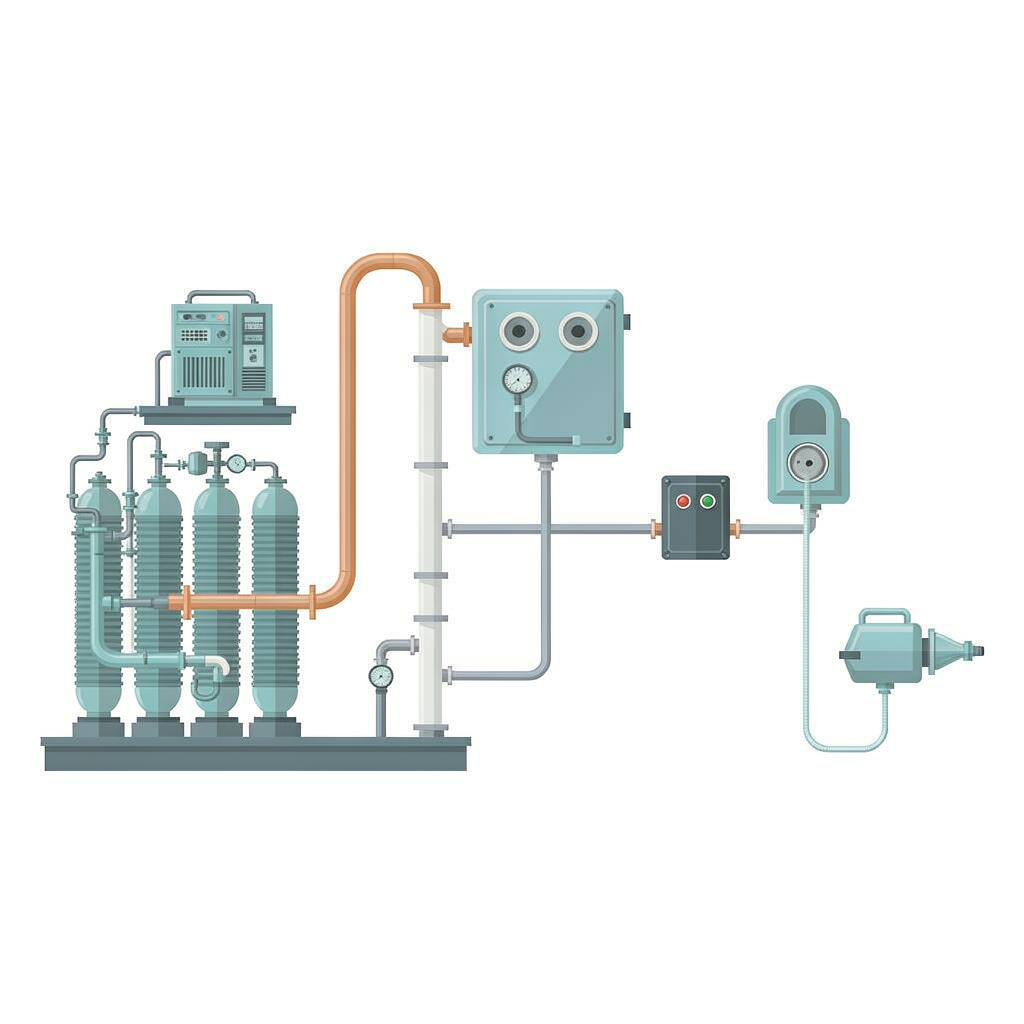
- Source equipment — the starting point of supply. It includes a medical gas manifold that links cylinder banks or liquid oxygen tanks, a medical air compressor that produces clean compressed air, and a medical vacuum system that creates suction. Many hospitals also add on-site oxygen generators.
- Pipeline network — medical-grade copper pipes carry the gases. These pipes are cleaned and degreased before installation so the gas stays pure.
- Zone valve boxes — valves that let staff shut off the gas supply to one ward or operating room without stopping the rest of the hospital.
- Alarm panels — monitors that watch pressure in real time and warn staff before a supply problem affects patients.
- Terminal units (medical gas outlets) — gas-specific outlets at the bedside or on the operating room wall. Each outlet accepts only one type of gas, which prevents wrong connections.
How Gas Reaches the Patient: Step by Step
- Gas is stored or produced at the central source, such as a manifold room or plant room.
- Manifolds and regulators reduce the pressure to a safe working level.
- Gas flows through the cleaned copper pipeline network to each floor.
- Zone valves control the flow into each ward, ICU, or operating room.
- Area alarm panels track pressure and alert staff if it moves outside the normal range.
- Staff connect a ventilator, flowmeter, or suction device to a gas-specific outlet, and gas is delivered at a stable pressure.
Each stage includes a safety check. If pressure drops in one zone, staff get an alert before it becomes a patient safety issue.
Why Purity and Pressure Matter
Medical gases must stay clean, dry, and at the right pressure. Installers degrease every pipe and braze joints under nitrogen purge to stop oxide scale from forming inside the pipeline. Gas-specific outlets and colour coding keep each gas separate, so an oxygen hose can never fit a vacuum socket. These details protect both the equipment and the patient.
Safety Standards That Govern the System
- ISO 7396-1 — the international standard for medical gas pipeline systems, covering design, installation, and testing.
- NFPA 99 — the health care facilities code widely used in the United States.
- HTM 02-01 — the guidance used in the United Kingdom for pipeline design and operation.
A compliant system should follow the standard required in its market. Buyers should always ask suppliers for compliance documents before placing an order.
What Buyers Should Focus On
- Compliance documents for the standards in your market
- Redundant source equipment so supply continues during maintenance
- Properly certified, degreased copper piping
- Gas-specific outlets and clear colour coding
- Alarm panels in every critical care area
- Qualified installation, testing, and after-sales support
Medical gas infrastructure does more than move gas through pipes. It directly supports patient care in every department. To understand the bigger picture, read our article on the vital role of medical gas systems in modern hospitals.
In Summary
A medical gas system takes gas from a central source, controls its pressure and purity, and delivers it safely to the point of care through pipes, valves, alarms, and outlets. Understanding this flow helps buyers ask the right questions and choose a system that keeps patients safe and hospitals running.


